- Independence Day Sale — save $100 on selected hearing aids with code IND100
- Free shipping on all orders
- Free hearing consultation with a licensed audiologist
- Rated 4.3 out of 5 from 61 customer reviews

Tinnitus
That ringing in your ears has a name.
If you hear ringing, buzzing or hissing that nobody else can hear, you are not imagining it — and you are far from alone. It is called tinnitus, and there is far more that can be done about it than most people realise.
Talk to an audiologistof adults worldwide live with some form of tinnitus
US adults experienced it for five minutes or longer in the past year
experience it severely enough to disrupt daily life
The basics
What tinnitus actually is
Tinnitus is the perception of sound when there is no external source making it. It is not a disease in itself — it is a symptom, usually of something happening in your hearing system.
For most people, only they can hear it. It might be constant or come and go, sit in one ear or both, and it often becomes most noticeable in a quiet room at the end of the day.
People describe it as
Causes
What can bring it on
The mechanism is not fully understood, but these are the factors most commonly linked to it.
Loud noise
Years of exposure at work, on machinery, at concerts or shooting ranges — the most common thread of all.
Getting older
Tinnitus often arrives alongside age-related hearing loss, and the two frequently turn up together.
Head or neck injury
Trauma can affect the nerves and structures involved in hearing, sometimes in one ear only.
Some medications
A number of drugs list tinnitus as a side effect. Never stop a prescribed medicine without speaking to your doctor.
Living with tinnitus
Tinnitus can be managed — often very well.
Here is the honest picture. There is no cure that reliably switches tinnitus off for good, and anyone promising one is overselling. If you have recently been told that, it can land hard — but it matters far less in practice than it sounds, because tinnitus responds well to management.
For many people it also becomes genuinely easier over time. The brain gradually learns to filter the sound out, much as it filters out a fridge humming in the next room. That process is called habituation, and it is well documented.
Most people who live well with tinnitus get there through some combination of sound therapy, amplification and understanding what is happening. A hearing professional is the right place to start.

Relief
How hearing aids can help
Tinnitus and hearing loss commonly occur together, which is why hearing aids are one of the main tools used for relief.
01
They bring the world back up
When everyday sound returns to a normal level, tinnitus stops being the loudest thing in a quiet room and simply has more to compete with.
02
Built-in sound therapy
Many models can play soft, tuned sound — ocean waves, gentle noise or fractal tones — that sits underneath the ringing and takes the edge off it.
03
Less strain, less focus on it
Straining to hear is tiring, and tiredness and stress make tinnitus louder. Hearing comfortably breaks that loop, and over time your brain pays it less attention.
Shop
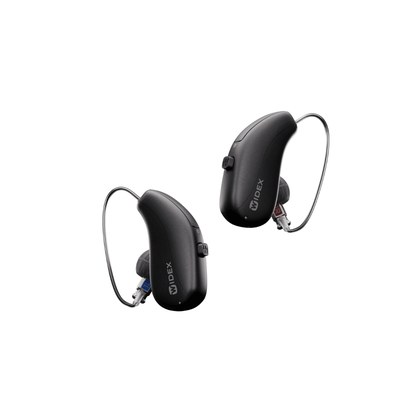
Hearing aids with tinnitus features
These models include a dedicated tinnitus programme from the manufacturer — Starkey Multiflex, Widex Zen, Oticon SoundSupport, Phonak Tinnitus Balance, ReSound Tinnitus Relief and Signia Notch Therapy.
Before you shop
When to talk to a doctor first
Most tinnitus is not dangerous, and most of it is managed rather than treated. But a few patterns are worth having checked by a clinician before you consider a hearing aid — occasionally they point to something specific and treatable.
This page is general information, not medical advice.
In one ear, or sudden
Tinnitus in a single ear, or that arrived abruptly rather than creeping in over years.
Pulsing with your heartbeat
A rhythmic whooshing that keeps time with your pulse, rather than a steady tone.
With dizziness or hearing loss
Especially if your balance is affected, or your hearing dropped over days rather than years.
Let us find out what is behind it.
Book a free, no-obligation consultation with a licensed audiologist. We will talk through what you are hearing and what your options actually are.
Sources: National Institute on Deafness and Other Communication Disorders (NIDCD), Tinnitus.
Jarach CM, Lugo A, Scala M, et al. Global Prevalence and Incidence of Tinnitus: A Systematic Review and Meta-analysis. JAMA Neurology. 2022;79(9):888–900.